

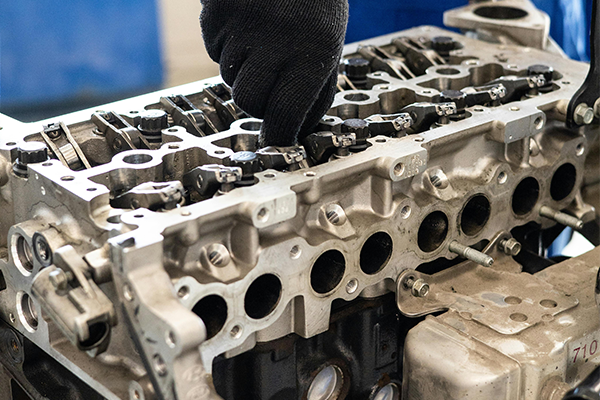
Cylinder head testing plays a central role in production and quality assurance. In the automotive and mechanical engineering industries in particular, it is crucial to detect hidden defects such as sand inclusions, core fractures or closures at an early stage in order to avoid costly recalls or failures. An industrial CT system opens up completely new possibilities in non-destructive testing – fast, precise and automated.
Reliable defect detection: an industrial CT scanner identifies defects in cylinder heads
Modern industrial CT systems make it possible to analyse cylinder heads in detail and reveal even the smallest irregularities that would be difficult to detect with the naked eye or other inspection methods. High-resolution imaging makes it possible to identify various defects that can significantly impair both the functionality and longevity of the component.
From porosity to hairline cracks - these four critical defect types can be detected in cylinder heads:
- Material defects and porosities: Small air pockets or cavities in the material that indicate defects in the casting process. Such porosities can impair the stability and strength of the cylinder head.
- Sand inclusions: Remains of sand trapped in the material during production. These inclusions can lead to weak points and later to fractures.
- Core fractures: Cracks or fractures in the material core that reduce the mechanical load-bearing capacity. Such fractures can lead to serious damage during operation.
- Hairline cracks: Very fine cracks that are difficult to detect but can severely impair the service life and tightness of the cylinder head.
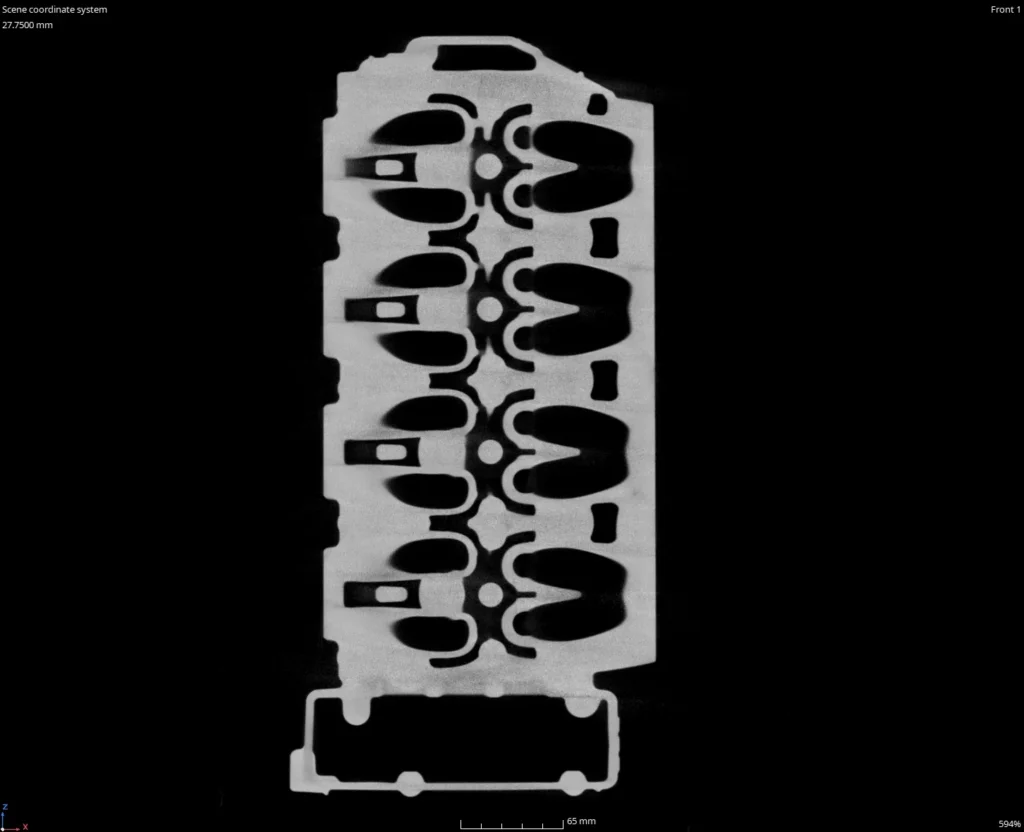
2D view of the cylinder head
If defects in the cylinder head remain undetected, this can disrupt combustion and lead to a loss of power and increased fuel consumption. In severe cases, there is a risk of engine damage due to overheating or failed seals.
Technical challenges in the series testing of cylinder heads
The inspection of cylinder heads for internal defects also poses a number of technical challenges. Factors such as the fine detail recognition, the complex design and the material properties of the component influence the image quality and require specially adapted inspection methods to ensure reliable results.
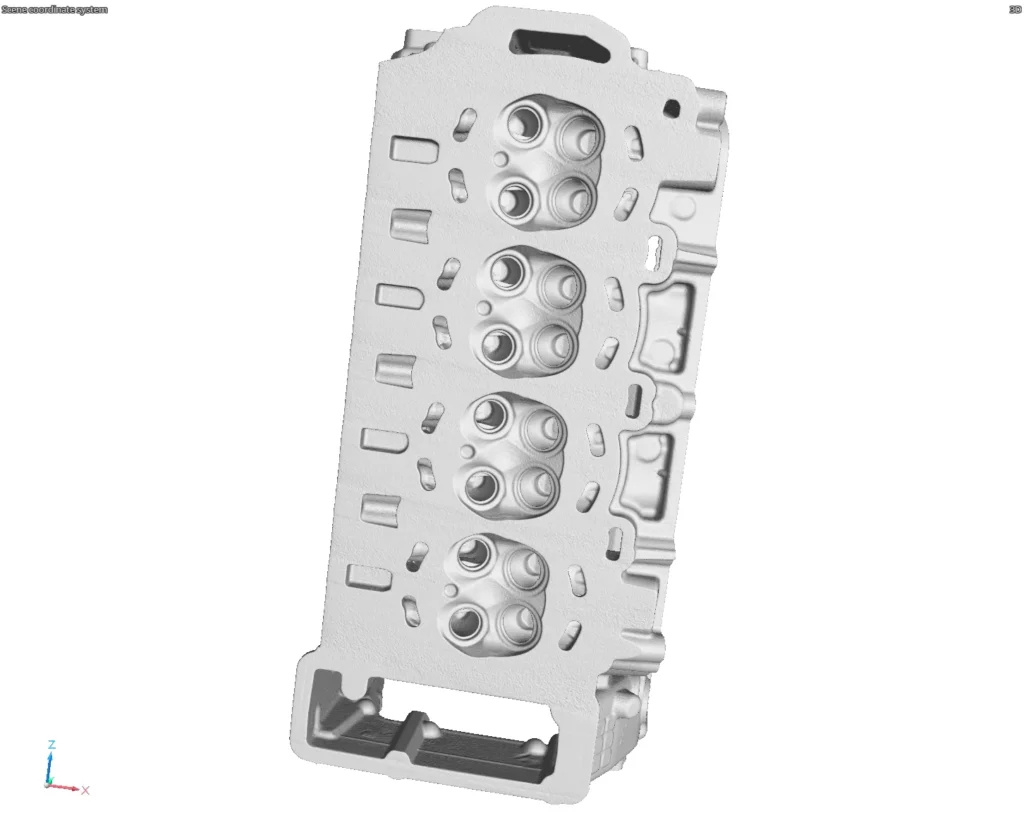
3D view of the cylinder head
- Resolution and contrast: In order to detect fine defects such as hairline cracks, the CT scanner must offer a very high resolution. At the same time, the contrast between the defect and the surrounding material is often low, which makes detection more difficult.
- Complex geometries: Cylinder heads often have complex internal structures. This complexity can make it more difficult to examine all areas equally.
- Material differences: Different materials (e.g. aluminum in combination with special sealing materials) can have different X-ray transmittances, which affects image quality and defect detection.
Time savings and precision: the measurable benefits of industrial CT inspection
Quick can
One of the outstanding advantages of the industrial CT system is its remarkable speed: a scan of a cylinder head only takes around 6 minutes per component. This short measuring time makes it possible to ensure a constant and efficient inspection process, even for large quantities. This allows manufacturing processes to be optimised and bottlenecks in production to be avoided.
Automatic layplan creatio
Immediately after the scan, sectional images of the cylinder head are automatically created. These high-resolution images provide a detailed insight into the component and make it possible to visualise even the smallest irregularities inside. The visualisation of the internal structure allows potential sources of defects to be quickly localised and specifically examined.
Automated defect detection
In addition to pure image acquisition, semi-automatic evaluation is also used. With the help of specialised CT evaluation software developed by Microvista, the generated cross-sectional images are analysed and possible defects, such as sand inclusions, core fractures or occlusions, are automatically detected. This automated approach significantly reduces manual effort and ensures consistent and reproducible evaluation of the components.
Cost-effectiveness in series production
The combination of fast scanning, automatic image generation and intelligent evaluation makes Microvista’s industrial CT system the ideal solution for high-throughput environments. Thanks to state-of-the-art technology and efficient inspection processes, defects can be reliably detected even in large series production – without slowing down the production process. In this way, we support companies in ensuring the highest quality standards and minimising reject rates.
Conclusion: ROI of CT technology - increasing efficiency and reducing errors in cylinder head production
The industrial CT inspection of cylinder heads optimises quality assurance through fast scanning times, automated image analysis and AI-supported defect detection. This minimises reject rates, reduces production costs and increases production efficiency – a worthwhile investment in the future of Industry 4.0. Our mobile industrial CT solution – the rentable ScanExpress – also enables extremely flexible and non-destructive testing, even for large quantities.