

In industrial production, even the smallest deviations in the production process or in raw materials can lead to the precautionary blocking of entire batches. As soon as a potential fault is identified, all associated components are blocked – regardless of whether they are actually all affected. The result: a large number of components are suddenly unused in the warehouse, even though they were firmly scheduled for customer orders.
The problem: Production downtime due to unclear error situation
The precautionary blocking of entire batches often leads to significant disruptions in the material flow. Without a quick and targeted error analysis, delays in delivery, additional storage costs and potential contractual penalties arise. In these cases, companies need a solution that quickly identifies non-conforming components and speeds up the re-release of flawless components.
The goal: Quick clarification of quality deviations with minimal effort
For effective decision-making, it is essential to determine promptly which components are actually faulty. This involves a sensible compromise between accuracy of analysis, time expenditure and cost-effectiveness. This is because complex individual tests cost valuable time, while imprecise procedures increase the risk of incorrect deliveries.
The solution: Technically sound express service for fault analysis
Our specialised express service for blocked batches offers fast, image-based inspection and classification of affected components. We rely on automated image-based inspection systems that are specifically tailored to the type of defect in question.
- Our approach is based on the following guideline:
- Image quality only as high as necessary: The spatial resolution is chosen to enable reliable and efficient defect detection - unnecessarily time-consuming scans are eliminated.
- Optimized inspection algorithms: Inspection is based on typical defect patterns - reliably and with high repeatability.
- Resource conservation: The pragmatic use of our software for automated evaluation of CT data reduces time and costs without compromising the quality of the inspection.
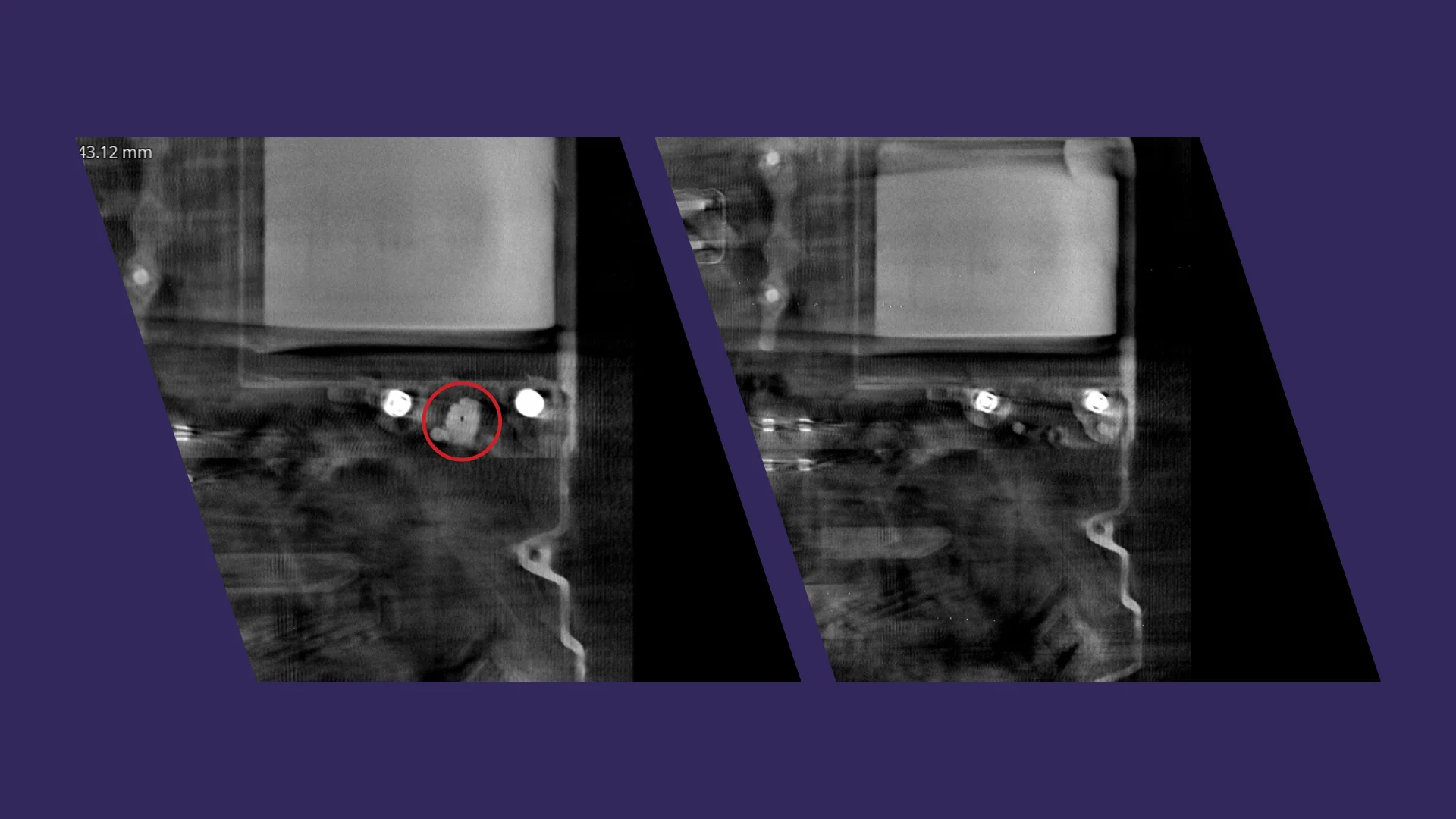
Particle in a component (left: NOK, right: OK)
Typical fault patterns and applied test methods
Our system for rapid fault analysis reliably recognises a large number of frequently occurring production faults:
Geometric deviations
Dimensional overruns or deformations are recognised by comparison with CAD models and taking permissible tolerances into account.
Material defects
Inclusions or blowholes are recognised by AI algorithms and assessed according to their size and location.
Assembly defects
Missing parts, incorrect positions or positions are reliably detected using comparison methods (e.g. golden part) or AI-supported image analysis.
The respective test strategy is customised – depending on the component geometry, urgency and defect pattern. In this way, we guarantee an optimum ratio of effort, speed and informative value of the results. Microvista has a toolbox full of software modules that can be linked together and enable a mature, fully or semi-automated process for rapid implementation of the testing strategy.
The result: fast approval, stabilised processes
With our technical express service, blocked batches can be quickly released or specifically sorted out – based on clear, reliable data. This relieves your warehouse, prevents unnecessary production downtime and secures delivery deadlines.
Conclusion: Technically sophisticated error analysis saves time and costs
Our solution combines error detection, process reliability and efficiency – especially for situations with high time pressure and an uncertain error situation. With targeted quality inspection based on modern image processing systems, we support you in avoiding production downtimes and keeping your supply chain stable.
Rely on quick decisions in the event of quality deviations – with our express service for industrial fault analysis.